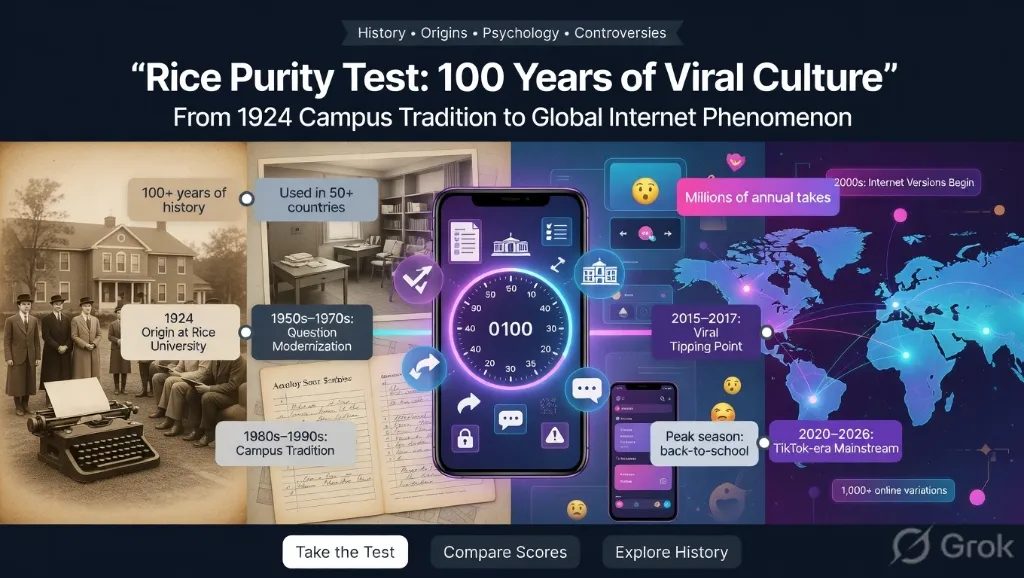
The Original Rice Purity Test: Full History From 1924 to 2026
Take the Rice Purity Test Now
100 questions · Free & anonymous · Get your purity score instantly and compare with friends.
Start the Test →The Original Rice Purity Test: From a 1924 College Survey to a Global Phenomenon
You've probably taken the Rice Purity Test at some point — maybe at 2 AM with your roommate, or in a group chat where someone randomly dropped the link. But have you ever stopped to wonder... where did this thing actually come from?
The answer is way more interesting than you'd think. 🎓
Where It All Started: Rice University, Houston
The Rice Purity Test originated at Rice University in Houston, Texas. Yes, it's named after an actual university — not the grain. (You'd be surprised how many people think it has something to do with actual rice.)
The test was first created as a self-graded survey that incoming freshmen would take during orientation week. The idea was simple: give students a way to gauge their life experiences and bond with their new classmates over shared (or not-so-shared) experiences.
It wasn't meant to judge anyone. It was meant to break the ice.
The Original Format
The earliest versions of the test were printed on paper and handed out during orientation events. Students would:
- Read through a list of experiences
- Check off the ones they'd done
- Calculate their score (out of 100)
- Compare with friends
The questions covered everything from "Have you held hands romantically?" to much more... advanced experiences. The range was intentional — it was designed to include something for everyone, regardless of their background.
Fun fact: The original test had slightly different questions than the version circulating today. Over the decades, students updated the list to reflect changing cultural norms and experiences.
How It Spread Beyond Rice University
For decades, the Rice Purity Test stayed mostly within Rice University's campus culture. But then the internet happened.
The 2000s: Forum Era
In the early 2000s, the test started appearing on college forums and message boards. Students from other universities discovered it, took it, and shared it with their own friend groups. It slowly spread from campus to campus.
The 2010s: Social Media Boom
When Twitter and Instagram became mainstream, the Rice Purity Test found a new home. People started posting their scores as a flex (or a confession). Screenshots of scores went viral, and suddenly millions of people who had never heard of Rice University were taking the test.
The 2020s: TikTok Changed Everything
This is where it went nuclear. 🚀
TikTok creators started making videos like:
- "POV: Your rice purity score is 23"
- "Taking the Rice Purity Test with my boyfriend"
- "Questions that made me PUT MY PHONE DOWN"
These videos racked up millions of views. The hashtag #ricepuritytest has over 500 million views on TikTok alone.
What Changed Over the Years?
The test has evolved quite a bit since 1924:
| Era | Key Changes | |---|---| | 1924-1960s | Paper-only, Rice University exclusive | | 1970s-1990s | Questions updated to match cultural shifts | | 2000s | First online versions appear | | 2010s | Goes viral on Twitter/Instagram | | 2020s-2026 | TikTok phenomenon, multiple versions created |
The core concept has never changed though: 100 questions, self-graded, anonymous, no judgment. That simplicity is exactly why it's lasted 100+ years.
Why "Purity" Test?
The word "purity" is a bit outdated, and some people find it problematic. The creators weren't trying to imply that certain experiences make you "impure" — the name was just a product of its time (the 1920s, after all).
Today, most people understand that the test is just for fun. A lower score doesn't make you a bad person, and a higher score doesn't make you boring. It's simply a snapshot of the experiences you've had so far.
Your score will literally change over your lifetime. That's the whole point.
The Rice Purity Test in 2026
Today, the test is bigger than ever. Here's what's different about the 2026 version:
- Instant digital results — No more paper calculations
- Score sharing — Send your results directly to WhatsApp, Snapchat, or drop it in your Tinder bio 🔥
- Score meaning pages — Detailed breakdowns of what every score means
- Community features — Comments, likes, and discussions
- Mobile-first design — Because 90% of people take it on their phones
The modern version keeps the spirit of the original while making it accessible to a global audience. Whether you're a freshman at Rice University or a college student in Mumbai, the experience is the same.
Take the Test Yourself
Curious where you stand? The test takes about 8-10 minutes and covers 100 questions about life experiences ranging from innocent to... well, you'll see.
No data is saved. No sign-up needed. Completely anonymous.
👉 Take the Rice Purity Test now
After you get your score, check out our detailed Score Meanings Guide to understand exactly what your number says about you.
From a 1924 campus survey to a 2026 global phenomenon — the Rice Purity Test proves that some things never go out of style. 🎓✨
Ready to find your score?
Take the Rice Purity Test →Comments (0)
Related Posts
Rice Purity Test: Complete History, Origins & Why It Went Viral
Discover the fascinating history of the Rice Purity Test, from its 1924 origins at Rice University to becoming a viral internet phenomenon among Gen Z.
Crush Purity Test for Couples: A Fun Way to Know Each Other (2026)
Take the Crush Purity Test as a couple to compare scores, spark deep conversations, and learn about each other's love history. The perfect date-night game.
Crush Purity Test Score Meaning: What Your Number Really Says (2026)
Got your Crush Purity Test score and not sure what it means? Here's the full breakdown of every score range — from Daydreamer to Love Veteran — and what it says about your love life.